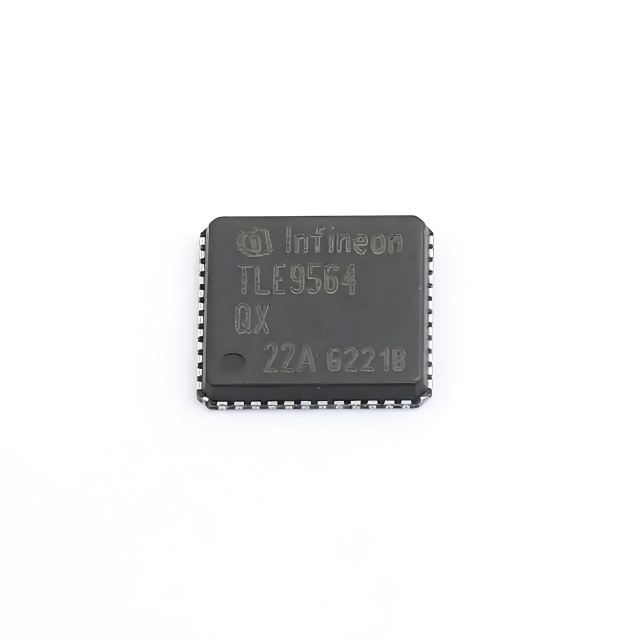
Manufacturer: Infineon Technologies
Key Specifications
- Package: VQFN-48
- Core: Not applicable (analog/mixed-signal)
- Memory: To be verified
- Interface: SPI
- Voltage: 5.5V - 28V (supply)
- Temperature: -40°C to 150°C (junction)
- Channels: 4 half-bridges (to be verified)
- Protection: Overcurrent, overtemperature, short-circuit (to be verified)
The TLE9564QX from Infineon Technologies is a dedicated automotive multi-channel half-bridge driver designed for precise control of DC motors, solenoids, or resistive loads in body and chassis applications. It integrates a high-voltage supply, SPI control interface, and comprehensive diagnostic and protection features into a compact VQFN-48 package, enabling robust and efficient actuation in harsh automotive environments.
Key Features
- Multiple half-bridge outputs (exact channel count to be verified) with configurable PWM control via SPI
- Wide supply voltage range from 5.5V to 28V, suitable for 12V and 24V automotive systems
- Integrated protection functions: overcurrent, overtemperature, short-circuit, and undervoltage lockout (details to be verified)
- SPI interface for device configuration, diagnosis, and fault reporting
- Operating junction temperature range from -40°C to 150°C, meeting AEC-Q100 requirements (grade 0)
- VQFN-48 package with exposed pad for improved thermal performance
- Low quiescent current in standby mode (to be verified)
Applications
- Automotive body control modules (BCM) for driving relays, LEDs, or small motors
- DC motor control for mirrors, windows, seat adjustment, or HVAC flaps
- Solenoid and actuator drivers in transmission or braking systems
- Generic low-side/high-side switch applications requiring SPI diagnostics
Selection Guidance
When selecting the TLE9564QX, verify the exact number of half-bridge channels and the maximum output current per channel from the official datasheet, as these parameters are critical for your load requirements. Confirm the SPI protocol (frame format, clock speed) and the fault detection thresholds to ensure compatibility with your microcontroller. The device is designed for automotive environments; ensure your PCB layout follows recommended thermal and EMC guidelines provided in the datasheet.